A lot of the hotels we talk to are already using a version of dynamic pricing. RoomPriceGenie is the one we get asked about most, so here's what it does, what it does well, where it costs you money, and what we do instead.
I've spent my whole career specialising in pricing, be that at Premier Inn or rebooting National Express's whole pricing model. And for over two months we've had RoomPriceGenie's prices and our own running side by side on the same hotel.
What RoomPriceGenie is good at
An example I like to use is that if you're pricing by hand, you're effectively using a dustpan and brush to clean your hotel room. It works. It's hard graft. Never quite thorough.
RoomPriceGenie is a Henry. A proper hoover, and a massive step up from the dustpan. No shade to Henry, we love a Henry, and if you're on one you've already made a smart move. You'll still be doing the hoovering yourself, mind, and it'll never be quite perfect.
We're two things. The machine is a better machine, a Dyson to the Henry. And there's a professional cleaner holding the end of it, doing the room properly every day. All you have to do is open the door and check the room is clean.
The things RoomPriceGenie does well, it does very well. It writes prices straight into your booking system, several times a day, so nobody at reception keys anything. Every room has a floor and a ceiling, so the price can never fall through the floor. It tells you when a rush of bookings lands on one date. Every price comes with a one-line reason. And it's affordable, around £170 a month for a small hotel on the basic plan.
That closed loop matters more than any clever modelling, because a decent price that reaches your booking page beats a perfect one that doesn't.
How RoomPriceGenie prices
Say your best room averaged £100 a night last year.
The base. They start from that £100 and add 3%, to nudge your average up. That's your base price, £103. They don't like you touching it. It creeps up a few percent a year for inflation.
Then the shape. They add a percentage for each month and each day of the week, set from your history. July is +20%, Saturdays are +5%, so a July Saturday starts at about £130.
Then the market. They look at your competitors, both nearby hotels and Airbnbs. If the comps are running 10% above normal, your price goes up 10%, so £143.
Then your occupancy. You give them a target for each month. If July's target is 90% and you're sitting at 85%, prices come down across the month. Ahead of the target, up they go.
On top of that sit the extras: an automatic discount on the nights next to a sold-out night, a cut in the last few days if you set one, and a surge price when bookings spike.
That's the whole machine. A set of rules that push up or pull down your base price by a certain percentage, most of them typed in at setup.
Where it costs you money
The base is last year's average. If your Saturdays were £30 too cheap last year, the base carries the £30. The plan assumes the old prices were right, and we haven't met a hotel yet where they were, which is why anyone buys pricing software in the first place. Our first job at every hotel is a rate card built from your own demand, room by room, season by season, day by day, with a person looking at it. And we redo it every year, because rooms change.
The target is a hope. Most hotels set the target where they'd love to be. When you don't get there, and you often won't, the whole month gets cut, including the Saturdays that were going to sell out anyway. You end up priced too low for a target you were never going to hit. On the hotel below, their November plan sits about 20% under ours for exactly this reason.
The discount lands next to the sold-out night. A £150 Sunday sits between a full Saturday and a full Monday. RoomPriceGenie takes 30% off it, for a guest who has no other room to choose. That Sunday would have sold itself. It's there because RoomPriceGenie has no minimum-night fix on most booking systems, so a discount is all it can do. We release the stranded night instead and keep the price.
The last-minute cut. Their own example setting is 10% off on the last day. An empty room earns nothing, so it feels free. It isn't. Late bookers aren't price shoppers. They've got no choice. At one hotel we price, the guests who took the late deal paid about 17% less than the late bookers who didn't get one. Automatic cutting close to arrival feels proactive, but it typically costs you money. The prices keep moving, so it looks like the system is doing something, and that feels good. It's a bitter pill.
The floor and the ceiling do the pricing. At one 13-room hotel on RoomPriceGenie, one room sat on its ceiling for over a third of the year and on its floor for another fifth. For well over half the year the "algorithm" was a guardrail number somebody typed in at setup.
And nothing measures any of it. Its dashboard shows what you took. It can't show what another price would have made, so it can't tell when it's wrong.
How we set your rate card
Before anything moves, we build your rate card from your own demand: which rooms sell, which seasons, which days. A person builds it with you. We review it every year, because a room that nobody wanted two years ago might be the one selling out now, and inflation isn't the only thing that changes.
How we forecast
We forecast by looking at everything together. Your booking pace. The events on at the time. The specific day, this year's Saturday in August rather than last year's. What your competitors are doing. And what people are actually booking, checked every night against what we expected. Your Saturday in February and your Saturday in August are different animals, and so is this August against last August.
How we price
Your rate card is the anchor, and every price we set is measured against it.
Picture a 14-room hotel three weeks out from a Saturday. Eleven rooms are sold, we expect the last three to go, and the night has a 75% chance of selling out. So the price goes up, by as much as the guests who book that late will pay. Now a Tuesday a month out. Three rooms sold, three more expected. That night needs help, and it needs it now, while a lower price still has time to find a guest. So we cut early, while a cut still works.
Every move is a bet on what guests will actually pay, and we pick the price that makes you the most money. We never cut a whole month because a target's been missed, and we never cut the last day by rule. If we raise a night and the bookings don't come, it comes back down the next morning.
Want to run fuller than the pure revenue price gives you? Say so and we tilt it. Some hotels make their money in the bar.
And a person checks it. All models are wrong and some are useful, as the statistician George Box said. Ours gets most nights right, and a real revenue manager looks at every price and overrules the model when it's missed something it can't see.
Us vs RoomPriceGenie, same hotel, same bookings
Theory is cheap. So here's the proof.
One of our hotels moved to us from RoomPriceGenie in July and kept RoomPriceGenie running in the background, so every day we had both plans for every room and every date, and for over two months we've measured every single booking that came in against both of them.
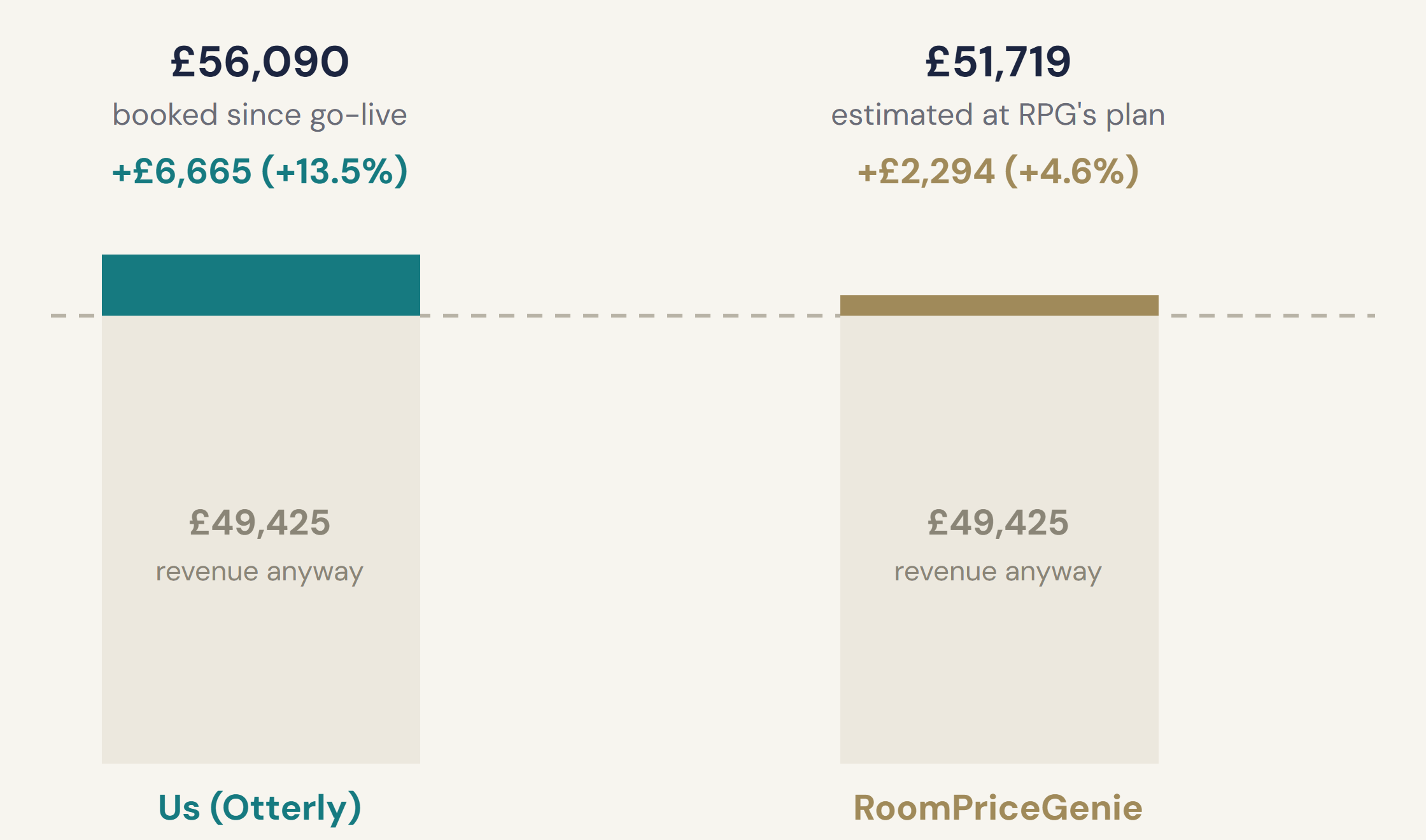
Same rooms, same nights, same guests. A great dynamic pricing model added 13.5%. A poorer one added 4.6%. Both beat the dustpan and brush, but you can see what the Dyson and the professional cleaner are worth.
About £2,500 of our number came from releasing single nights stranded between bookings by a two-night minimum. RoomPriceGenie can't do that on this hotel's system. The rest is pricing.
We show you the money
RoomPriceGenie misses this, and from running hotels we know it matters. We measure how much money you've made by using Otterly, and we're confident enough in the product to show it to you live.
You get a dashboard of your whole business: revenue, occupancy, how you're doing against last year, where we think you'll finish the year month by month, and where each day is heading, with pacing charts for every date ahead and the weak days flagged before they arrive.
Most hotels find it incredibly valuable for running the business. It tells you when to run a marketing campaign and when to pull a lever, and we're proud that plenty of our hotels use it as the main driver of their performance.
Should you switch?
Absolutely. We're price competitive with RoomPriceGenie for a much better model, with the business performance package included for free, and we promise 3x your money back in extra revenue. We're so confident in it that we measure it for you, on a dashboard, so you can check for yourself.
Want to find out more?
Don't want to switch, but want more out of RoomPriceGenie? Here are our suggestions.
- Set the target to what you actually did last year, never to what you'd love to do.
- Open Lead Time Adjustments and set the last-day row to 0.
- Turn the shoulder-night discounts off. Release the stranded night by hand instead, and keep the price.
- Check each room's floor and ceiling against its calendar. If a room sits on either for a month, the setting is the price.
- Review the base price yourself once a year.
And spend half an hour a day checking the prices. All models are wrong, and nobody at RoomPriceGenie is looking at yours.
Want to see what we'd do with your prices?
Otterly Booked runs pricing for UK independent hotels. Keep RoomPriceGenie on in the background if you like, and we'll show you the two plans side by side on your own bookings. Book a demo and we'll go through your hotel with you.
Written by Nathan Noerr, who runs pricing at Otterly Booked. He has over 12 years running pricing at travel companies such as Premier Inn and National Express.