
- Property
- Damson Dene, Lake District
- Size
- 57 rooms
- Booking system
- Guestline
- With us since
- August 2026
Damson Dene joined Otterly Booked in July. Their most pressing issue was that their direct prices were being undercut on Booking.com, and they couldn't understand the root of the problem.
Getting to rate parity
The first thing we did was write a rate parity report. It showed exactly how the price a guest saw on each travel agent was built. It covered the Genius discounts, the mobile rates, the member rates and the agents' own sponsored discounts, and how they stacked on top of each other. On Booking.com, a deal and a Genius discount stacked to take four rooms 17.6% below the price the hotel sent. Then we put one price everywhere, so guests no longer had a reason to skip the hotel's website and book through an agent.
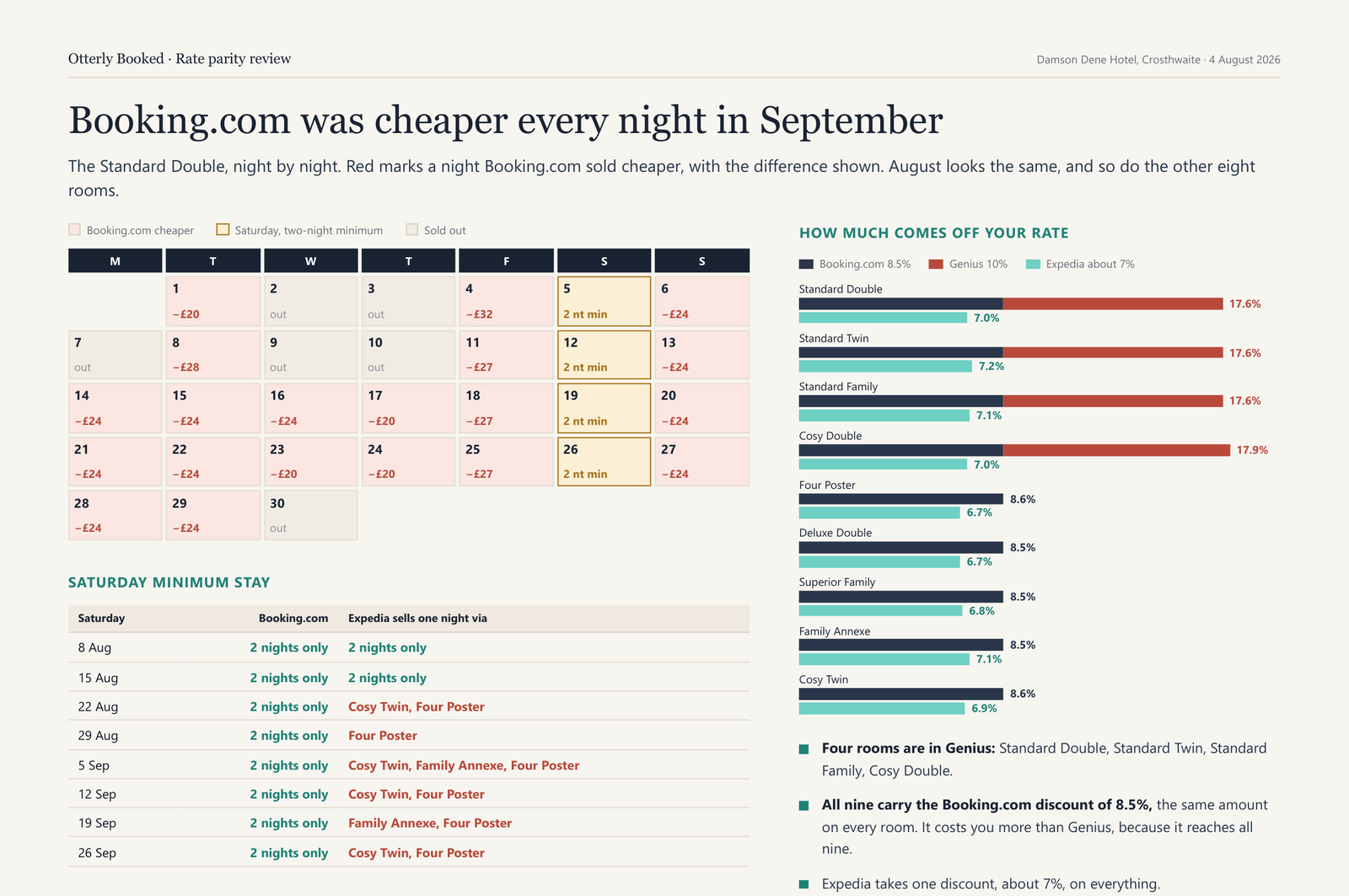
An additional problem we found was that while Damson had a two-night minimum on its weekends, Expedia wasn't honouring it, and was selling single nights 75% of the time. We changed the Expedia settings to match the hotel's own, so the two-night minimum now applies everywhere.
While we fixed the initial problem, Booking.com and Expedia carried on undercutting each other, and as a result undercut the hotel's direct prices. Expedia's automatic rate matching undercut Booking.com's sponsored discount, which in turn undercut Expedia's rate matching. We worked with both sides to stop the price war and have a reset period, which let us reach price parity. We still check it constantly, so there's never a better price anywhere online than on the hotel's own website.
Using the travel agents to work for Damson Dene
Once we'd reached rate parity, we wanted to take advantage of the upside of the travel agents, which is their fantastic distribution. We use targeted visibility tools, paid for with commission, not rate. Guests see the same price everywhere and still have a reason to book direct, but Damson Dene shows up higher in the rankings on the nights where it needs it most. On the quiet nights, we alert the marketing team so they can switch these tools on.
We use targeted visibility tools, paid for with commission, not rate.
Increasing direct bookings
With rate parity in place, we worked with the marketing team at the hotel on direct-only offers and book-direct campaigns, slowly increasing the share of guests who book direct. The reasons to book direct aren't just about price. Guests who book on the hotel's own website get late checkout, free date changes, their choice of room and free use of the pool and leisure club.
Pricing per room
We found that Damson Dene was pricing per person, when a hotel's stock is its rooms, not its people. Pricing per person leaves significant money on the table, and makes it much harder to price effectively and fairly. So we moved Damson Dene to a price per room model, where we keep the extras like breakfast and dinner on a per person basis.
Along the way we found summer 2027 had never been loaded into Guestline, and was selling at almost a quarter below this summer's prices. We loaded the new prices and updated the rate card, so guests got the price they were meant to see.
Rebuilding the rate card
Damson Dene had a rate card based on estimates of its seasons. We rebuilt it with a data-driven approach, from actual booking data and what guests were willing to spend. That card is the cornerstone of how Otterly's pricing engine works, and it's imperative we get it right to optimise pricing for the hotel.
We then taught the engine what guests actually spend once they arrive, in the restaurant and around the hotel as well as on the room. So we price for total revenue per available room, not just room revenue. We worked with the team and the owners to tune it.
Releasing minimum nights where demand is low
Someone at the hotel used to release the weekend minimums on the Monday before, if they felt demand was low. We analyse this three months in advance, so guests get the longest possible window to book a single night where demand is more limited.
Otterly working paw in paw with marketing
We have a system that spots when demand is falling behind budget, and alerts the marketing team. That lets them build offers specifically to fill the soft gaps. So we can price competitively where demand is weak, and where it needs extra support, we lean on the marketing team, working paw in paw. They've built fantastic Christmas packages, Black Friday offers and many more.
Other early alerts
Otterly can also see when demand falls behind where we expected it to be. In October, coach tours were cancelling late and the voucher sites were picking up slowly. At one point we expected November to finish over £16k behind the year before. We saw it well in advance, updated our prices and worked with the marketing team, and within a week we'd closed the gap by over £10k, despite the tour cancellations and the slow deals.
We also saw heavy discounts being given at the reception desk, with no set rules to guide them. We gave the team a discount sheet and set prices to use. Now the discounts go where they really earn something, and the hotel isn't giving away rooms that would otherwise sell.
We sit down every month with the owners
We review how the past month went, and make plans and adjustments for the coming months, to make sure we're maximising value for the team.
The result
Otterly is so much more than a dynamic pricing engine. It's people with pricing expertise, spotting problems early, finding the root cause and fixing it, so owners can get on with what they do best, running their hotel and giving guests a great stay.
Damson Dene is a 57-room hotel and a complex operation. We've helped it make £31,421 more, 5.9% extra revenue. Its direct revenue is up 44%, its room rate rose 12% over the busy summer months, and it's on track for a winter that beats last year, in what is a hard market for many hotels.
Additional revenue generated
Want to see what we'd do with your prices?
You set the limits, a person checks every price, and you can stop us any time. Hotels from £150 a month, with no setup fee and no contract.